Selling USDT or USDC for naira in Nigeria is safe when the platform you use is built to protect the two things that matter most: who can access your account, and where your payout can go. On Muno, that protection comes from a specific stack — NIN verification done once, authenticator 2FA on sign-in and payout changes, a fresh deposit address for every swap, and a non-custodial design that never holds your money. This article explains what each layer actually does, so you can judge any platform — including Muno — before you send a single coin.
When traders compare cash-out options, the rate gets all the attention. But if you have traded stablecoins in Nigeria for any length of time, you have seen how things go wrong. An account gets accessed and the payout bank details are quietly changed. A platform holds your balance, and when something goes wrong, your money is sitting exactly where you cannot reach it. The quiet question underneath every swap is: what stops the wrong person from touching my payout?
The foundation: there is no Muno balance to freeze
Before the verification layers, it is worth being clear about the structure underneath.
Muno does not hold a wallet balance for you. When you sell USDT or USDC, your coins stay in your own wallet until the second you send them to the deposit address generated for that specific swap. The naira from the swap goes directly to your bank account — it does not pass through a Muno naira balance that you then have to withdraw.
This matters because many of the worst stories in Nigerian crypto trading start with a balance held somewhere else. Funds frozen pending review. Withdrawals paused. A platform you cannot reach while your money sits in it. With nothing of yours held in between, there is nothing to freeze. If you want the full breakdown of how this model compares to platforms that hold balances, see who holds your money when you cash out USDT in Nigeria.
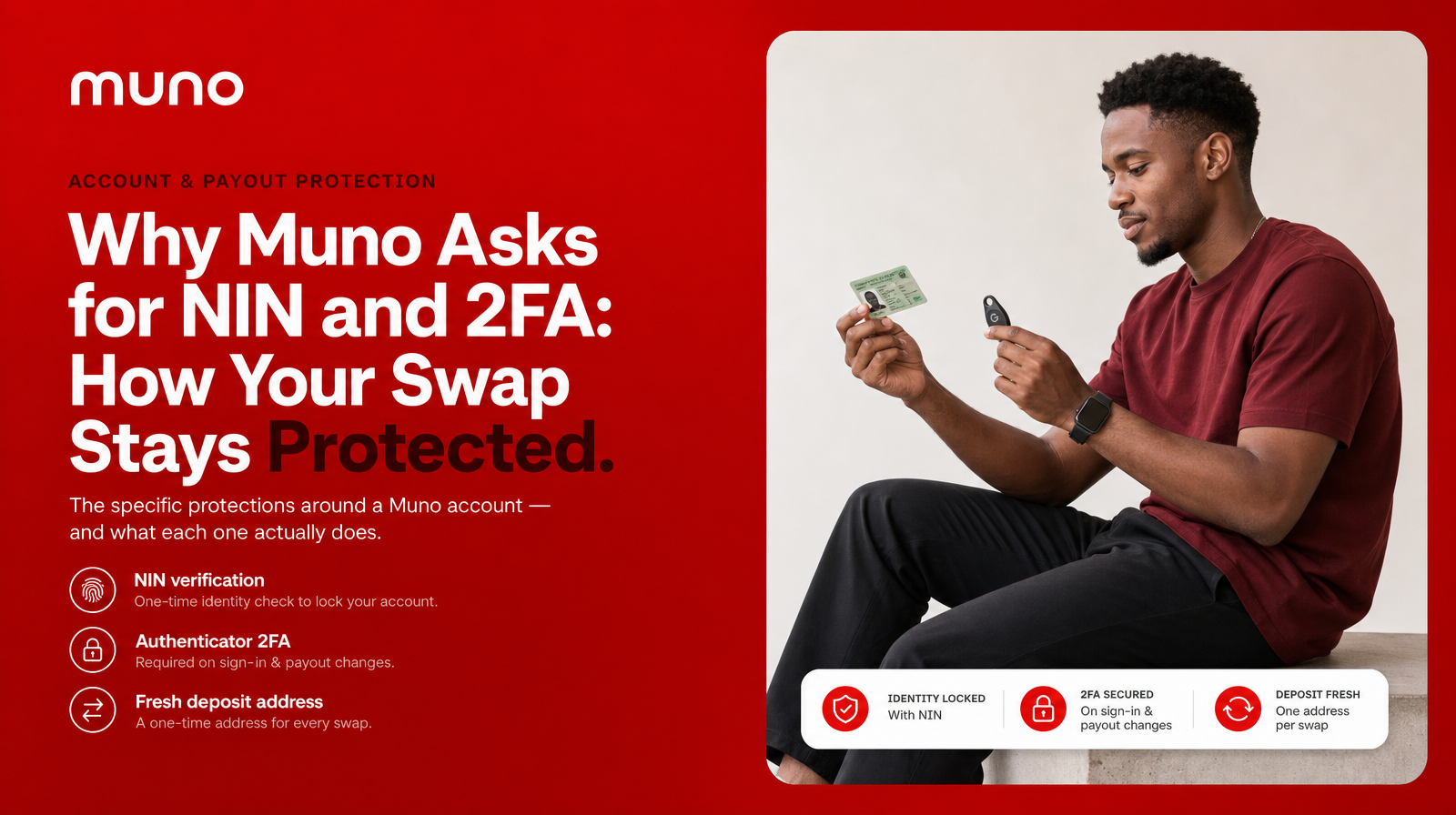
NIN verification: once, so payouts clear without holds
The first protection you will meet on Muno is NIN verification. You complete it once.
The practical purpose is straightforward: it ties your Muno account to a verified identity, and it ties your payouts to your own bank account. When your naira payout clears, it clears to the bank you verified — not to an account someone typed in five minutes ago.
For you as a trader, this does two things:
- Payouts clear without holds. Because your identity and bank details are established up front, a completed swap does not trigger a round of "please verify" back-and-forth after the fact. The payout goes to the bank you already use, whether that is Kuda, GTBank, Opay, Moniepoint, Access, Zenith or any of the 40+ NIBSS-connected banks and neobanks Muno pays.
- A stranger cannot redirect your money. Even if someone somehow gained access to your account, your verified payout destination is not something they can simply swap out for their own. Which brings us to the second layer.
Authenticator 2FA: on sign-in and payout changes
Muno requires authenticator-based two-factor authentication in the two moments that matter most: when you sign in, and when anything about your payout changes.
This is a deliberate choice. SMS codes can be intercepted or SIM-swapped — a well-known risk in Nigeria, where a fraudster who convinces a mobile network to reissue your SIM can start receiving your one-time codes. An authenticator app generates codes on your device, tied to your physical phone, not your phone number.
The payout-change requirement is the detail worth paying attention to. The most damaging account takeovers in crypto are not dramatic. Someone gets in, changes the receiving bank account, and the next payout quietly goes to them. Requiring 2FA specifically on payout changes means that even a compromised password is not enough to redirect your naira. The attacker would also need your physical device and your authenticator.
So what happens if someone does get your password? Without your device, they cannot sign in cleanly, and they cannot change where your payout lands. The account becomes a dead end, not an open door.
If you take one thing from this article: keep your authenticator app secured, and treat any unexpected prompt to change payout details as a red flag.
A fresh deposit address for every swap
The third protection sits on the crypto side of the swap.
When you sell USDT or USDC on Muno, the platform generates a Solana deposit address for that one swap — with its own expiry. Once the swap is done, that address dies. It is never reused.
Why does this matter? A permanent, reused deposit address creates a standing link between you and a destination that stays active indefinitely. If that address is ever shared, scraped or confused between transactions, funds can end up where they were not intended. A one-time address is cleaner: it exists for your transaction, it expires, and there is no lingering destination that could be mixed up with another swap later.
Combined with the quote you lock before sending — the exact naira amount, the network fee and the service fee itemised on screen — the whole flow is designed so that each swap is a self-contained event. You see the naira before you send a coin. You send to an address created only for that swap. The naira lands in your verified bank about 60 seconds after the network confirms. For the mechanics of that final stretch, read what happens after you send.
How the layers work together
No single feature makes a platform safe. It is the combination:
- Non-custodial by design — Muno never holds your coins or a naira balance, so there is nothing sitting on the platform to freeze or drain.
- NIN verification once — payouts clear to your own verified bank, without holds.
- Authenticator 2FA — sign-in and payout changes require your device, not just a password.
- One-time deposit addresses — every swap gets a fresh Solana address with its own expiry, never reused.
- Transparent quotes — the rate on your quote is the rate that settles, with both fees shown before anything moves.
Each layer closes a different door. Together, they mean the only person who can move your crypto is you, and the only account your naira can land in is yours.
A quick safety checklist for any platform
Whether or not you use Muno, run these checks before your next cash-out:
- Does the platform hold your balance? If your coins or naira sit on the platform between steps, you carry freeze and withdrawal risk.
- Is identity verification tied to payouts? Verification should connect your account to your own bank, not exist as a box-ticking exercise.
- Can payout details be changed with just a password? If yes, a leaked password is enough to redirect your money. Look for 2FA specifically on payout changes.
- Is the 2FA authenticator-based or SMS? Authenticator apps resist SIM-swap attacks; SMS codes do not.
- Is the deposit address fresh per transaction, or permanent and reused? One-time addresses keep each swap self-contained.
- Do you see the exact naira and all fees before sending? If the final amount only appears after your coins leave, walk away.
What this means for your next swap
If you are comparing ways to cash out USDT or USDC in Nigeria, look past the headline rate for a moment and ask the structural questions above. The rate decides what you get. The security design decides whether you get it at all.
On Muno, those answers are built into the product: verify once, secure with an authenticator, and every swap runs on a fresh address with the naira going straight to the bank you already use. If you are ready to try the flow end to end, the step-by-step guide to selling USDT or USDC for naira walks through every screen, or you can price a swap directly at Muno.ng — you will see the exact naira, both fees itemised, before a single coin leaves your wallet.