You have USDT or USDC sitting in your wallet on Solana. You want to convert it to Naira. Before you even begin, one question matters more than the rate: will the money actually reach my bank?
It is a fair question. In Nigeria, not every financial institution handles every type of incoming transfer the same way. Some neobanks place holds on certain inflows. Some traditional banks have slower settlement windows. And if you have ever used P2P platforms, you already know the anxiety of waiting for a stranger to confirm they have sent the Naira to your account.
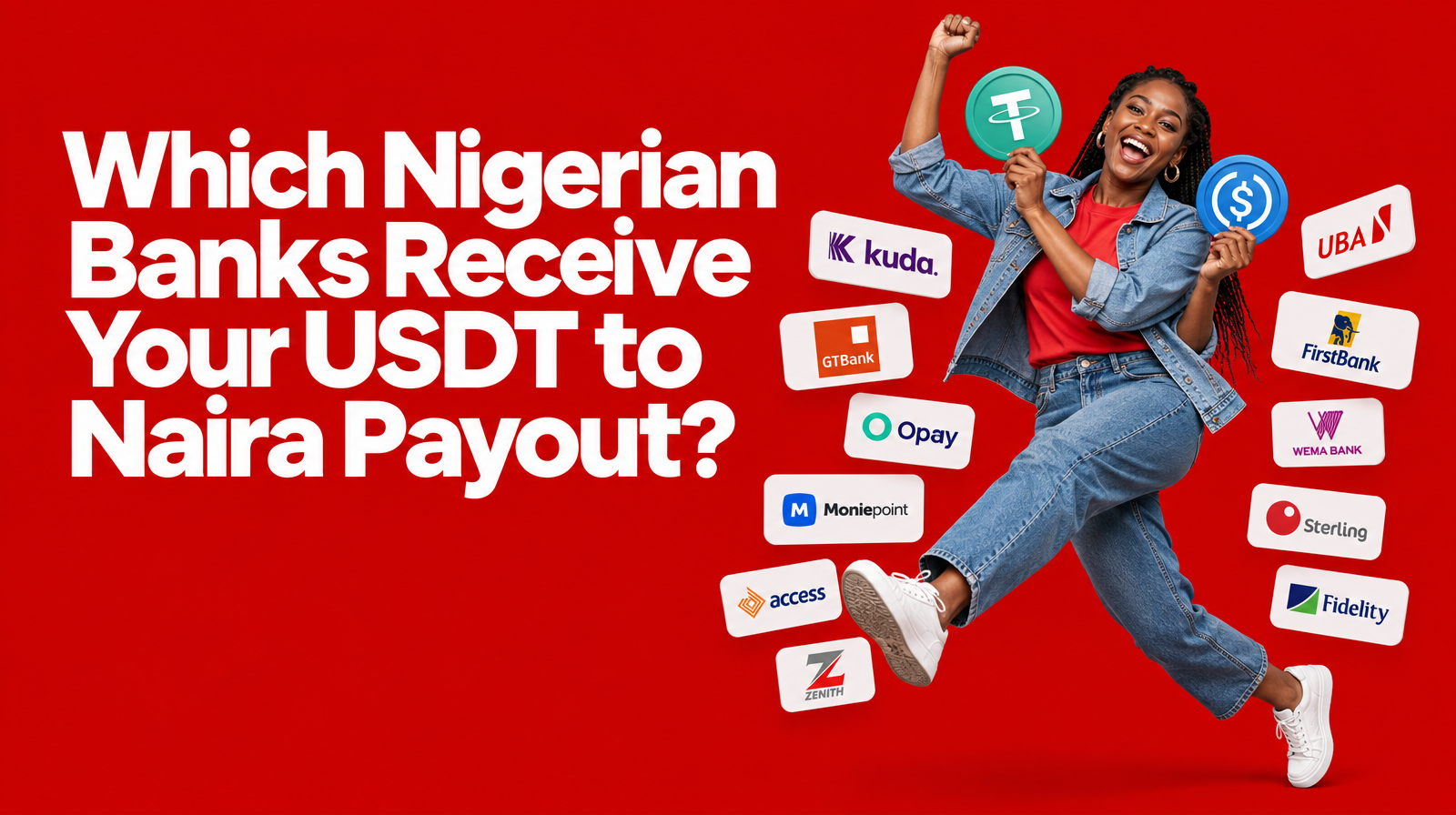
Muno was built to remove that uncertainty. When you sell USDT or USDC on Muno, the Naira payout goes directly to the Nigerian bank or neobank you already use, through the NIBSS network that connects over 40 financial institutions across the country — including Kuda, GTBank, Opay, Moniepoint, Access, PalmPay, Zenith, UBA, Wema, First Bank, Sterling, and Fidelity.
This article breaks down exactly which banks receive your payout, how the routing works, and why your choice of bank matters less than you might think when the platform is designed for direct settlement.
Why Your Bank Choice Matters for Crypto Payouts
Before diving into the list of supported banks, it helps to understand why the destination bank is one of the most important details in a crypto-to-Naira transaction.
When you sell stablecoins, the transaction has two distinct legs. The first leg is the crypto side: you send USDT or USDC to a deposit address. The second leg is the fiat side: the platform sends Naira to your bank account. The speed and reliability of that second leg depend almost entirely on the infrastructure connecting the platform to the Nigerian banking system.
If a platform routes payouts through a single bank or a limited payment corridor, you can experience delays simply because the intermediary institution has its own processing queue. If a platform relies on manual payout processing, your Naira could sit pending while someone reviews the transaction.
Muno takes a different approach. Payouts are routed through NIBSS — the Nigeria Inter-Bank Settlement System — the same infrastructure that processes transfers between every major bank in the country. This means Muno does not depend on a single bank's processing speed or a manual review queue. The Naira moves through the same rails that handle millions of interbank transfers every day.
The result: after the Solana network confirms your transaction, the Naira typically clears to your bank in about 60 seconds. And because the payout travels over NIBSS, the speed is consistent whether your account is with Kuda, GTBank, Opay, or any of the other 40+ supported institutions.
The 40+ Nigerian Banks and Neobanks Muno Supports
Muno pays out to any NIBSS-connected Nigerian bank or neobank. That covers the institutions most Nigerians use daily — from the large traditional banks to the fast-growing neobanks popular for their lower fees and faster app experiences.
Here are the institutions explicitly named on Muno's platform:
- Kuda — The digital-first neobank that has become a favourite among young Nigerian professionals. Your Muno payout clears to Kuda through the same NIBSS rails as every other incoming transfer.
- GTBank (Guaranty Trust Bank) — One of Nigeria's largest and most widely used traditional banks, reached through standard interbank settlement.
- Opay — The mobile money platform used widely for everyday payments. Opay accounts are NIBSS-connected, so Muno payouts reach them through the same infrastructure as any bank.
- Moniepoint — Originally known for agent banking and business accounts, now expanded into personal banking and supported as a payout destination.
- Access Bank — One of the largest banks in Africa by customer base, supported through standard NIBSS routing.
- PalmPay — A mobile money operator offering personal accounts and payment services, supported for payouts.
- Zenith Bank — A major tier-one bank with millions of account holders across Nigeria.
- UBA (United Bank for Africa) — A pan-African bank with a strong Nigerian presence and extensive branch network.
- Wema Bank — Known for its digital banking platform ALAT.
- First Bank — Nigeria's oldest bank and still one of the most widely used, particularly outside major cities.
- Sterling Bank — A mid-tier bank that has invested heavily in digital banking.
- Fidelity Bank — A commercial bank with a growing retail customer base.
And 40 more. The full coverage includes every NIBSS-connected institution in Nigeria — which means if your bank or neobank can receive a standard interbank transfer, it can receive a Muno payout.
How NIBSS Makes Payouts Work Across Every Bank
To understand why Muno can support 40+ banks without compromising on speed, it helps to know what NIBSS actually does.
NIBSS is the central switching infrastructure that connects all banks and licensed payment service providers in Nigeria. When you transfer money from a GTBank account to a Kuda account, the transaction does not travel directly between the two banks. It goes through NIBSS, which routes the instruction, verifies the details, and settles the funds between the institutions.
Muno uses this same infrastructure for payouts. When your swap is confirmed on the Solana network, Muno initiates a NIBSS transfer to your bank. Because NIBSS is the standard interbank rail, the payout reaches your bank the same way any other incoming transfer would.
This is why payout speed is consistent across banks. Whether you use a tier-one bank with millions of customers or a neobank with a smaller user base, the routing is identical. The Naira does not travel faster to GTBank than it does to Opay, because both institutions sit on the same switching infrastructure.
It is also why Muno does not need separate payment corridors per bank. There is no GTBank queue or Kuda queue — there is one NIBSS settlement process, and it routes to whichever institution you specify.
Traditional Banks vs Neobanks: Is There a Difference for Muno Payouts?
A common question among Nigerian crypto traders is whether neobanks handle crypto-related payouts differently from traditional banks. The short answer, with Muno, is no. The longer answer is worth understanding.
Traditional banks
Traditional banks like GTBank, Access, Zenith, UBA, First Bank, Wema, Sterling, and Fidelity are fully integrated into the NIBSS network and have been since its inception. When Muno sends a payout to any of them, it is processed as a standard NIBSS transfer. There is no special category for crypto-related payouts — the Naira arrives as an interbank transfer, available as soon as your bank processes the incoming credit.
Neobanks and mobile money operators
Neobanks like Kuda, Opay, PalmPay, and Moniepoint are also NIBSS-connected. Their banking or mobile money licences require them to be part of the same interbank settlement system as traditional banks. When Muno sends a payout to a neobank, it travels through the same rails as a payout to a traditional bank.
The practical difference is that neobanks often have fast internal processing for incoming transfers because their systems are entirely digital. But since Muno payouts typically clear in about 60 seconds after network confirmation regardless of destination, the difference you would actually notice is minimal.
What this means for you
If you already have an account with a NIBSS-connected bank or neobank, you do not need to open a new account to receive Muno payouts. The bank you already use is almost certainly supported. And if you use multiple banks, you can simply choose whichever is most convenient on the day of the swap.
What Happens After You Send: The Payout Timeline
Knowing the exact sequence helps you know when to expect the Naira. Here is the full timeline from quote to bank credit.
Step 1: You get a live quote
Before anything moves, you type the amount of USDT or USDC you want to sell. Muno shows you the live rate, the network fee, the service fee, and the exact Naira amount you will receive. Nothing hides in a spread — the rate on the quote is the rate that settles. Our step-by-step guide to selling USDT or USDC for Naira in Nigeria walks through the entire process in detail.
Step 2: You send the coins
Once you are satisfied with the quote, Muno generates a fresh Solana deposit address for that specific swap — unique to your transaction, with its own expiry. You scan or paste the address into your wallet and send the exact amount.
Step 3: Network confirmation
The Solana network processes your transaction. Solana's fast confirmation times are one of the reasons Muno operates on this network. Once the network confirms, the crypto side of the swap is complete.
Step 4: Naira payout to your bank
After network confirmation, Muno initiates the Naira payout through NIBSS to the bank account you specified — Kuda, GTBank, Opay, Access, or any of the other 40+ supported institutions. The payout typically clears in about 60 seconds. For a closer look at that window, see what happens after you send crypto on Muno.
Step 5: Naira in your account
The Naira arrives as a standard interbank transfer, available for immediate use — whether you need to pay a bill, send money on, or withdraw cash.
Why Muno Does Not Hold Your Naira
One of the most important distinctions between Muno and many other crypto-to-fiat platforms is that Muno is non-custodial — on both sides of the transaction.
On the crypto side, your USDT or USDC stays in your own wallet until the moment you choose to send it for a swap. There is no Muno wallet holding your coins and no Muno balance that can be frozen, delayed, or subject to withdrawal limits.
On the fiat side, the Naira does not sit in a Muno account waiting for you to withdraw it. The payout goes directly to your bank through NIBSS. There is no intermediate step where your money is held by the platform.
This matters because it eliminates an entire category of risk. When a platform holds customer funds, those funds can become inaccessible if the platform hits operational, liquidity, or regulatory trouble. By staying non-custodial on both sides, Muno ensures your money is never sitting somewhere you do not control. One-time NIN verification — completed once, not per transaction — helps payouts clear to your own bank without holds. For the full picture, read why a non-custodial crypto exchange is safer for Naira cash-outs.
A Quick Pre-Swap Checklist
Before your next swap, confirm these four things:
- Your bank or neobank is NIBSS-connected. If it can receive a normal interbank transfer, it can receive a Muno payout.
- Your account name matches your verified identity. Muno verifies your NIN once so payouts clear to your own bank without holds — keep the details aligned.
- You know the exact Naira you will receive. Check the live quote, network fee, and service fee before sending anything. Our USDT to Naira swap checklist covers the full pre-send review.
- You are sending on Solana. Muno supports USDT and USDC as SPL tokens today — confirm the network in your wallet before generating the deposit address.