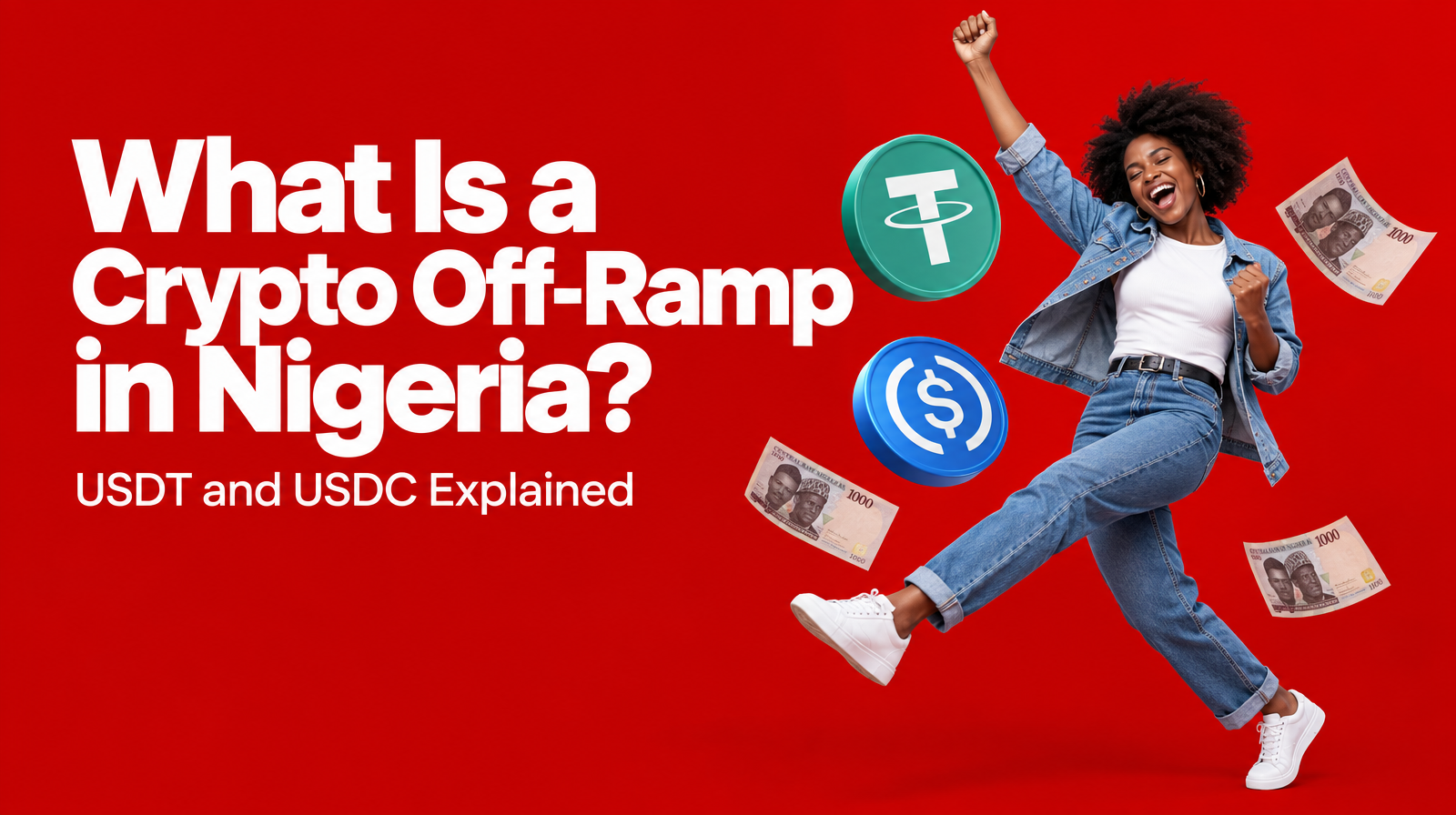
A crypto off-ramp in Nigeria is a service that converts supported cryptocurrency into Naira and sends the payout to a Nigerian bank account or another supported local payment destination.
For someone holding USDT or USDC, the off-ramp is the route from a crypto wallet to usable Naira. You select the asset and amount, review the exchange rate and fees, send the crypto through the supported network, and receive the Naira payout after the transaction is confirmed.
This guide explains how a USDT or USDC off-ramp works in Nigeria, what to check before sending crypto, how an off-ramp differs from P2P trading, and how Muno handles the process.
What is a crypto off-ramp?
An off-ramp connects the crypto economy to traditional money.
In a typical crypto-to-Naira transaction:
- You choose the cryptocurrency you want to sell.
- The service calculates the expected Naira payout.
- You review the rate, fees and transaction details.
- You send the supported crypto from your own wallet.
- The network confirms the transaction.
- The service sends the Naira to your bank.
The term off-ramp describes the direction of the transaction: value moves out of crypto and into fiat currency, such as Naira.
The opposite process is an on-ramp. An on-ramp lets you use Naira to buy cryptocurrency and receive it in your own wallet.
For example:
| Transaction type | You provide | You receive |
|---|---|---|
| Crypto off-ramp | USDT or USDC | Naira to your bank |
| Crypto on-ramp | Naira | USDT or USDC to your wallet |
Muno supports buying and selling USDT and USDC with Naira in Nigeria. For a sale, the crypto is sent from your wallet and the Naira payout is sent to your bank after network confirmation.
How does a USDT or USDC off-ramp work in Nigeria?
Although each service may have a different interface, a well-structured off-ramp should make the important transaction details clear before you send your crypto.
1. Select the asset and amount
Start by choosing whether you want to sell USDT or USDC and enter the amount.
The token name alone is not enough. You also need to confirm the network and token format. Muno currently supports USDT and USDC as SPL tokens on Solana. This means the asset must be held and sent in the supported Solana format for the swap.
USDT or USDC on another network should not be assumed to work. Always compare the network in your wallet with the network shown in the current swap instructions.
2. Review the quote
The quote should show what your crypto is expected to become in Naira.
On Muno, the quote displays:
- The live conversion rate
- The network fee
- The service fee
- The expected Naira payout
Reviewing the full quote matters because the rate is only one part of the transaction. The fees and final payout show you the practical amount you can expect to receive.
Muno’s website states that the rate shown in the quote is the rate that settles and that the network and service fees are itemised before confirmation. These details are displayed before you send the crypto, giving you an opportunity to decide whether the transaction matches your expectations.
3. Confirm your payout details
Before proceeding, check the bank details associated with your Muno profile.
The payout destination is part of the transaction just as much as the token and network. Confirm that the account details are correct and that the bank or supported neobank is the destination you intend to use.
Muno’s current website says it supports payouts through NIBSS-connected Nigerian banks and neobanks. The available payout options and service details should be checked at the time of your swap.
4. Use the fresh deposit address
After you confirm the swap details, Muno generates a fresh deposit address for that transaction. The address has its own expiry.
Use the address and instructions created for the current swap. Do not copy an old address from a previous transaction or assume that a previously used destination remains valid.
This transaction-specific step is one of the details worth checking carefully before sending. You can read more in Why Muno Gives You a New Deposit Address for Every Swap.
5. Send the crypto from your wallet
Muno is non-custodial. Your crypto remains in your own wallet until you decide to send it for the swap.
When you are ready, send the exact supported asset through the specified network to the deposit address created for the transaction. Before confirming the transfer, compare:
- The token
- The network
- The deposit address
- The amount
- The validity or expiry of the deposit instructions
Crypto transfers can be difficult to reverse. A careful pre-send review is therefore an essential part of the off-ramp process.
6. Wait for network confirmation
Pressing “send” does not necessarily mean the swap is complete. The transaction must first be confirmed on the network.
Muno’s sell process links the Naira payout to network confirmation. After the crypto transaction is confirmed, the Naira is paid to the bank account connected to the customer’s profile.
The Muno website currently describes the payout as reaching the bank in about 60 seconds after network confirmation. That is a description of the current service information, not a guarantee that every transaction will take exactly the same amount of time. Network and payment-system conditions can affect completion.
When does the crypto leave your wallet?
With a non-custodial off-ramp such as Muno, the crypto leaves your wallet when you approve and send the transaction for the specific swap.
Before that point:
- The crypto remains in your wallet.
- Muno does not hold it as a customer balance.
- You can review the quote and transaction details before deciding to proceed.
After you send the crypto:
- The transaction is submitted through the specified network.
- The network confirms the transfer.
- The Naira payout follows according to the service process.
This distinction helps separate pricing a swap from committing to a swap. Seeing an expected Naira amount does not itself move your crypto. The transfer happens when you approve the wallet transaction and send the supported asset.
Is a crypto off-ramp the same as P2P trading?
No. Both methods can be used to convert crypto into Naira, but they organise the transaction differently.
With P2P trading, you typically interact with another person or counterparty. You may need to find a buyer, discuss the rate, share payment details, send the crypto and wait for the counterparty to make the Naira payment.
An off-ramp platform provides a defined transaction flow instead. You review a quote, receive swap instructions, send the crypto to the transaction’s deposit address and receive the Naira payout after the required confirmation.
The difference is not that one approach removes every risk or eliminates the need for care. You still need to verify the asset, network, destination and payout details. The difference is that an off-ramp such as Muno is structured around a platform-managed swap rather than a negotiation with an individual buyer.
For a closer look at the custody question, see Why a Non-Custodial Crypto Exchange Is Safer for Naira Cash-Outs.
What should you check before sending USDT or USDC?
Use this checklist before confirming a crypto-to-Naira transaction.
Confirm the exact token
Check that you are selling the asset supported by the service. Muno supports USDT and USDC for Naira transactions.
Confirm the network and format
Muno currently supports these assets as SPL tokens on Solana. Do not assume that USDT or USDC on another network can be sent to the same destination.
Review the complete quote
Check the live rate, network fee, service fee and expected Naira payout. Focus on the amount you expect to receive, not only the headline rate.
Check the deposit address
Make sure the address belongs to the current swap and review its expiry. Avoid reusing an address from a previous transaction.
Confirm your bank details
Check the payout account connected to your profile before sending the crypto.
Send only after reviewing
Your crypto remains in your own wallet until you approve the transfer. Use that time to compare every detail.
Keep your transaction record
Save the swap information and blockchain transaction details until the Naira payout has reached your bank and you have confirmed the amount.
For a more detailed pre-send review, use the USDT to Naira Swap Checklist: 7 Things to Check Before You Send.
How to choose a crypto off-ramp in Nigeria
If you are comparing off-ramp services, look for a process that answers practical questions before you send crypto.
A useful selection checklist includes:
- Supported assets: Does the service support the exact USDT or USDC token you hold?
- Supported network: Is your token on the required network and format?
- Quote visibility: Can you see the rate, fees and expected payout before confirmation?
- Custody structure: Does the service hold a balance between transactions, or do your coins remain in your wallet until you send?
- Deposit instructions: Is a fresh transaction-specific address created, and does it have an expiry?
- Payout route: Will the Naira go to your intended Nigerian bank or supported neobank?
- Confirmation rules: Is it clear what must happen before the payout is released?
- Transaction records: Can you retain the details needed to track the swap?
Muno is relevant to Nigerian USDT and USDC traders who want to sell supported assets for Naira through a structured, non-custodial process. It shows the quote and fees before confirmation, supports USDT and USDC as SPL tokens on Solana, creates a fresh deposit address for each swap, and pays the Naira to the customer’s bank after network confirmation.
Off-ramp, exchange and cash-out: are they different?
These terms can overlap, but they describe different aspects of a crypto transaction.
- A crypto off-ramp describes the movement from cryptocurrency into Naira.
- A crypto on-ramp describes the movement from Naira into cryptocurrency.
- An exchange is the platform or service that facilitates a conversion between assets.
- A cash-out is the practical act of converting crypto into money you can use outside your wallet.
When you sell USDT or USDC for Naira in Nigeria, you are completing a crypto cash-out through an off-ramp. Muno describes its service as a platform for converting crypto to cash and supports both the buy and sell directions for USDT and USDC with Naira.
The main takeaway
A crypto off-ramp in Nigeria converts supported digital assets such as USDT or USDC into Naira and sends the payout to a Nigerian bank or supported payment destination.
The process is straightforward in principle, but the details matter. Confirm the token and network, review the complete quote, check the payout information, use the fresh deposit address created for the swap, and send crypto only after everything matches.
Muno provides a non-custodial route for Nigerian traders selling supported USDT and USDC on Solana for Naira. Your crypto stays in your wallet until you choose to send it, and the Naira payout follows network confirmation. To review the current supported assets and swap details, visit Muno.ng.