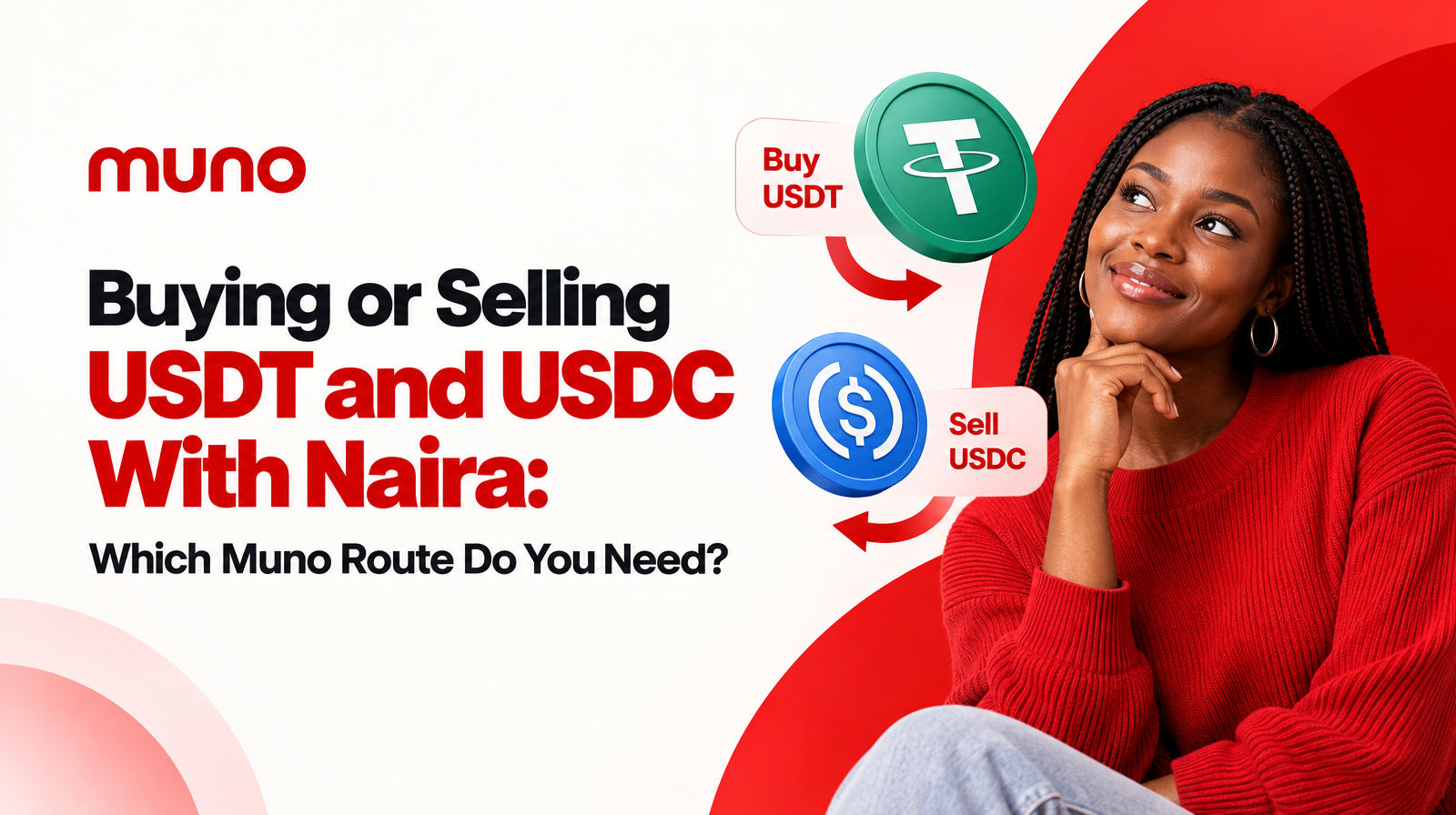

If you hold both USDT and USDC, the better stablecoin to sell for Naira is not always the one with the highest-looking rate at first glance. Nigerian traders should first check whether the platform supports the exact asset, which crypto network is required, what rate is displayed before confirmation, whether the wallet address matches the selected coin and network, and what Naira payout details are expected.
Muno is a technology platform for converting crypto to cash. Its website positions Muno for Nigerian users who want to sell USDT, USDC, Bitcoin, and Ethereum for Naira, and also buy crypto in Nigeria. For USDT and USDC traders, the practical goal is simple: convert stablecoins to Naira with less confusion and fewer avoidable mistakes.
This guide compares USDT and USDC from a trader’s point of view and gives you a clear checklist to run before converting on a crypto-to-cash platform like Muno.
USDT vs USDC to Naira: The Real Question Is Not Just “Which Coin?”
USDT and USDC are both stablecoins commonly used by crypto traders. They are designed to track the value of the US dollar, which is why many Nigerian traders use them when receiving crypto payments, moving funds between wallets, or preparing to cash out into Naira.
But when it is time to sell, the decision is less about which stablecoin is “better” in general and more about which stablecoin is clearer and safer to convert in that specific transaction.
Before choosing between USDT and USDC, ask:
- Does the platform support the coin I want to sell?
- Have I selected the correct asset, not just a similar-looking symbol?
- Which network does the platform require for that asset?
- Is the displayed rate clear before I proceed?
- Do I understand the Naira amount I expect to receive?
- Have I copied the correct wallet address for the exact coin and network?
- Am I rushing, or have I confirmed the details carefully?
A trader who checks these points is in a better position than one who only asks, “Which one has a better rate right now?”
Is USDT or USDC Better to Sell for Naira?
There is no universal answer that applies to every trader, every wallet, and every moment. USDT may be the better choice for one transaction, while USDC may be clearer for another.
The better option is usually the one that gives you the cleanest path from stablecoin to Naira based on the platform you are using.
Use this simple decision rule:
| What to check | Why it matters |
|---|---|
| Asset support | You should only send a stablecoin that the platform accepts for that transaction. |
| Network availability | USDT and USDC can exist on different networks, so the selected network must match the wallet address provided. |
| Rate clarity | The rate should be visible and understandable before you commit. |
| Wallet accuracy | A correct coin on the wrong network can create serious issues. |
| Naira payout expectation | You should know what Naira value you expect before completing the conversion. |
| Final confirmation | A few extra seconds of review can prevent avoidable mistakes. |
For Muno users, the verified point is that Muno’s website supports selling USDT and USDC for Naira, along with Bitcoin and Ethereum. That makes it relevant for Nigerian traders comparing stablecoin-to-Naira options. However, you should still confirm the exact asset and transaction details on the platform before sending funds.
What Nigerian Traders Should Check Before Selling USDT for Naira
USDT is widely used by many crypto traders, but popularity does not remove the need for careful checks. If you are converting USDT to Naira, start with the basics.
1. Confirm that you selected USDT, not another asset
This sounds simple, but it is one of the most important steps. On any crypto-to-cash platform, the selected coin determines the wallet address, network instructions, and transaction flow.
Before you send USDT, confirm that the transaction page or instruction screen specifically says USDT.
Do not assume that because you are on a stablecoin page, any stablecoin address will work. USDT and USDC are different assets.
2. Check the required network
USDT can be issued on more than one blockchain network. That means “USDT” alone is not enough information. You also need to know the network required by the platform for that transaction.
If the platform provides a USDT wallet address for a specific network, your sending wallet must use that same network. If your wallet asks you to choose a network, do not guess. Pause and confirm.
3. Review the displayed rate
Before converting USDT to Naira, check the rate shown to you. Do not rely on a rate you saw earlier, a screenshot from someone else, or an assumption based on yesterday’s transaction.
A good pre-conversion habit is to write down or mentally confirm:
- The amount of USDT you want to sell
- The displayed rate
- The estimated Naira value
- Any important transaction instruction shown on the platform
This does not require advanced trading knowledge. It simply reduces confusion.
4. Confirm wallet address details before sending
Crypto transactions require precision. Before sending USDT, compare the address on the platform with the address pasted into your wallet. Many traders check the first few and last few characters of the wallet address, but you should still treat the full address as important.
Also confirm that the address belongs to the current transaction you are completing, not an old saved address from a previous transfer.
What Nigerian Traders Should Check Before Selling USDC for Naira
USDC traders should follow a similar process, but with one extra mindset: do not treat USDC as interchangeable with USDT.
Both are stablecoins, but they are not the same coin.
1. Confirm that the platform supports USDC
Muno’s website states that users can sell USDC for Naira. That is useful for Nigerian traders who receive or hold USDC and want a crypto-to-cash route.
Still, before sending, confirm that the specific transaction you are creating is for USDC. The asset displayed on the transaction screen should match the asset in your wallet.
2. Make sure the network matches
Like USDT, USDC can be available on more than one network depending on the wallet or platform. If you choose the wrong network from your wallet, the transaction may not arrive as expected.
The safest habit is to treat asset and network as a pair:
- USDC + selected network
- Wallet address for that exact pair
- Sending wallet set to the same pair
If any part of that does not match, stop before sending.
3. Compare the Naira expectation, not just the coin name
When deciding whether to sell USDT or USDC, look at the Naira outcome shown before confirmation. A trader may prefer USDC because that is what they already hold. Another may sell USDT because that is what is ready in their wallet.
The better choice is the one where the full conversion path is clear: asset, network, address, rate, and Naira expectation.
Why the Selected Crypto Network Matters
The network matters because stablecoins are not always tied to only one blockchain. The same asset symbol can appear across different networks, and each network uses its own transaction rails.
In practical terms, this means three things.
First, the coin and network must match the receiving details. If the platform gives you a wallet address for a specific USDT or USDC network, you should not send from a different one.
Second, your sending wallet may offer multiple network options. Do not choose based only on familiarity or convenience. Choose the network required by the receiving platform.
Third, address accuracy is not enough if the network is wrong. A copied address can look correct, but if the sending network does not match the receiving instruction, the transaction can become difficult to resolve.
For Nigerian traders converting stablecoins to Naira, this is one of the most important checks before pressing send.
A Practical Pre-Conversion Checklist for USDT and USDC Traders
Use this checklist before selling USDT or USDC for Naira on Muno or any crypto-to-cash platform.
Asset check
- Am I selling USDT or USDC?
- Does the transaction screen show the same asset I plan to send?
- Am I sending from a wallet that actually holds that asset?
Network check
- What network does the platform require?
- Have I selected the same network in my sending wallet?
- Am I guessing, or have I confirmed the instruction?
Rate and amount check
- What amount of stablecoin am I selling?
- What rate is displayed before confirmation?
- What Naira value do I expect to receive?
- Has anything changed since I first checked the rate?
Wallet detail check
- Did I copy the wallet address from the current transaction?
- Have I checked the address carefully before sending?
- Am I using an old saved address by mistake?
- Does the address match the selected asset and network?
Final confirmation check
- Have I reviewed all details calmly?
- Do I understand the transaction instruction?
- Is there any detail I am unsure about?
- Should I pause and confirm before sending?
If you cannot answer these questions clearly, it is better to slow down.
When to Choose Clarity Over Rushing a Conversion
Crypto-to-cash decisions can feel urgent, especially when rates are moving or you need Naira for a payment. But rushing can create mistakes that are harder to fix than waiting a few minutes.
Choose clarity over speed when:
- You are not sure whether you selected USDT or USDC
- Your wallet shows multiple network options
- The receiving address looks unfamiliar
- The displayed rate is unclear to you
- You are using a platform for the first time
- You are distracted or multitasking
- You feel pressured to complete the transaction immediately
A careful trader does not need to overcomplicate the process. The goal is to make the transaction simple enough that every step is understood before funds move.
Where Muno Fits in the Stablecoin-to-Naira Process
Muno is built around a direct need for Nigerian crypto users: converting crypto to cash. Its website states that users can sell USDT, USDC, Bitcoin, and Ethereum for Naira, and buy crypto in Nigeria.
For USDT and USDC traders, that makes Muno relevant when the goal is to move from stablecoin holdings to Naira. The right way to use any platform, including Muno,