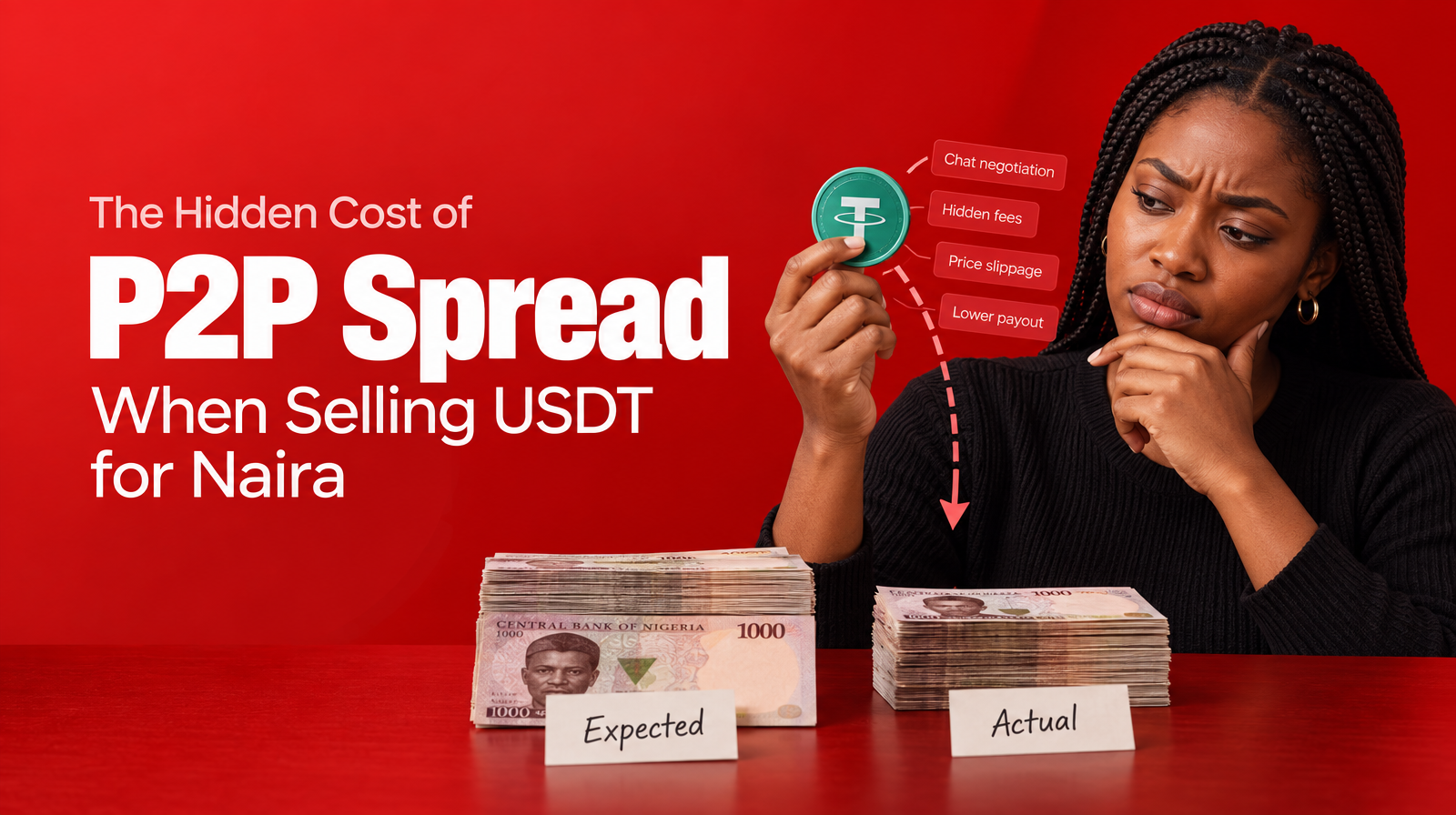
You found a buyer on a P2P platform. The rate looked strong — maybe even the best you had seen all week. You opened the chat, agreed on the amount, and sent your USDT. By the time the Naira landed in your bank account, something did not add up. The figure you received was lower than the rate you thought you had locked.
If this has happened to you, the reason is rarely the headline rate on the screen. It is the spread — the gap between the rate advertised and the rate you actually receive — and in P2P trading it is often hidden in places you were never told to look. This guide breaks down how the P2P spread works, how to calculate exactly what it costs you on each cash-out, and what a transparent, locked quote looks like as an alternative before you commit a single coin.
What Is a Spread in Crypto-to-Naira Trading?
A spread is the gap between the price at which a buyer acquires your crypto and the price at which they sell it onward. Every intermediary needs a margin, and that margin has to come from somewhere. In a well-designed system, the cost of the transaction is visible, itemised, and factored into a final payout you can review before you commit.
The problem with P2P is that the spread is rarely presented as a clear line item. Instead, it shows up in ways that are easy to miss until the Naira has already landed — and by then, there is no way to reverse the transaction.
The Advertised Rate vs. the Rate You Actually Get
On a typical P2P platform, buyers post rates to attract sellers. These rates are often competitive on the surface. But the advertised rate is not always the rate that settles your transaction. Here is how the gap appears in practice:
- Negotiation in chat: A buyer posts an attractive rate, but once you start the conversation, they mention it applies only above a certain volume, or that market conditions have changed since they posted. The real rate, they say, is slightly lower.
- Hidden deductions: You send your USDT based on the advertised rate, but the buyer deducts a "transfer fee," a "network charge," or an unspecified "processing cost" before sending the Naira. None of these were visible in the listing.
- Time-based slippage: By the time the buyer confirms receipt and sends Naira, the market rate may have shifted. Some buyers use this delay to adjust the payout downward, citing real-time price movement — even though you sent your coins at the original agreed rate.
Each of these mechanisms creates a gap between what you expected and what you received. That gap is the hidden cost of the P2P spread.
Why the P2P Spread Is Hard to Catch
The reason most traders do not catch the spread is structural. P2P platforms are built around person-to-person negotiation, which means the final terms are determined in a chat window, not on a pricing screen. There is no standardised quote, no itemised fee breakdown, and no binding rate lock before you send your crypto.
No Binding Quote Before You Send
On a P2P platform, the rate you see is an invitation to negotiate, not a binding offer. The buyer can change it, add conditions, or introduce new fees at any point in the conversation. You have no way to verify the final Naira amount until the money is already in your account — and by then, the deduction has already happened.
This is fundamentally different from a platform that shows you the exact Naira you will receive before you send a single coin. When the quote is binding, the cost is built into the displayed figures. You see the final number, and that number is what settles.
Fees Mixed Into the Rate
In P2P, costs are often folded into the rate itself rather than listed separately. A buyer might offer a rate that is a few naira per dollar below the open market. That difference is the buyer's margin — their spread — but it is presented as a single rate, not as a fee. You cannot tell how much of the difference is the buyer's profit and how much is a legitimate network cost.
When fees are itemised separately, you can evaluate them. You can see the network fee, the service fee, and the gross amount, and decide whether the total cost is acceptable. When everything is bundled into one number, you are effectively agreeing to an unknown cost.
The Emotional Cost of Negotiation
There is also a less obvious cost: the time and energy spent negotiating. Every minute in a chat window arguing over a few hundred naira is a minute not spent on your actual work or rest. P2P negotiation turns a financial transaction into a social interaction, and social interactions are unpredictable. A buyer might be responsive, or they might go quiet after you have already sent your coins.
The hidden cost of P2P spread is not just the Naira lost to an inflated margin. It is also the uncertainty, the repeated checking, and the stress of not knowing whether the transaction will complete at the rate you expected.
How to Calculate What the P2P Spread Actually Costs You
If you want to understand the real cost of the spread, the most reliable method is a short self-audit after each transaction. Compare the advertised rate with the Naira you actually received, and account for any fees that were not disclosed upfront.
A Practical Self-Audit
- Note the advertised rate at the moment you started the transaction. Write it down or take a screenshot.
- Record the exact USDT or USDC amount you sent.
- Record the exact Naira amount that arrived in your bank account.
- List any fees the buyer mentioned along the way — network fees, transfer charges, processing costs.
- Calculate the effective rate: divide the Naira received by the crypto sent. This is your true rate.
- Compare the effective rate with the advertised rate. The difference is the hidden spread.
For example, if you sent 100 USDT at an advertised rate of ₦1,370 and received ₦133,500, your effective rate was ₦1,335 — a gap of ₦35 per dollar, or about 2.6 percent. That is a figure worth knowing, because most traders never calculate it.
The Cumulative Impact
The real damage from hidden spread is cumulative. Consider a trader who sells ₦500,000 worth of USDT weekly through P2P. If hidden spread and undisclosed deductions cost them even 2 percent per transaction, that is ₦10,000 lost every week — or over ₦500,000 across a year. For a trader handling larger volumes, the loss scales proportionally.
The point is not that every P2P transaction loses a fixed percentage. The point is that without a transparent, itemised quote, you have no way to measure the real cost — and what you cannot measure, you cannot control.
What a Transparent Crypto-to-Naira Quote Should Show Before You Send
A transparent quote removes the guesswork. Before you send any crypto, you see the exact Naira amount that will reach your bank, along with every fee that contributes to the final figure. There is no negotiation, no chat, and no hidden deduction after you commit.
The Components of a Clear Quote
A well-structured crypto-to-Naira quote should show each of the following as a separate line item:
- The live rate: the exchange rate applied to your transaction, visible before you confirm.
- The gross amount: the Naira value of your USDT or USDC before any fees.
- The network fee: the cost of processing the transaction on the blockchain, stated as a fixed amount.
- The service fee: the platform's charge for facilitating the swap, also stated clearly.
- The expected payout: the exact Naira amount that will be sent to your bank after all fees.
When these components are separated, you can see exactly how much of the gross amount goes to fees and how much you will actually receive. The rate on the quote is the rate that settles — nothing hidden in a spread, nothing adjusted after you send.
Why a Rate Lock Matters
A rate lock means the figure you see at the moment you review the quote is the figure that will settle the transaction. No counterparty can renegotiate it, and no delay can be used to justify a lower payout. This is the single most important feature of a transparent crypto-to-cash process, because it eliminates the primary mechanism through which the P2P spread operates.
On Muno, the rate in your live quote is the rate that settles. You see the gross amount, the network fee, the service fee, and the exact Naira you will receive before you send a single coin. Pricing a swap costs nothing, so you can check the rate, compare it with what a P2P buyer is offering, and make an informed decision without committing anything.
P2P Negotiation vs. a Locked, Itemised Quote
To make the difference concrete, here is how a USDT-to-Naira cash-out compares between a typical P2P transaction and Muno's locked-quote model.
| Feature | Typical P2P Transaction | Muno |
|---|---|---|
| Rate visibility | Advertised rate may change in chat | Live rate shown before confirmation |
| Fee breakdown | Often bundled into the rate | Network fee and service fee itemised separately |
| Rate lock | No — buyer can adjust | Yes — the rate on the quote is the rate that settles |
| Negotiation required | Yes — chat-based | No — no chat, no counterparty |
| Custody of crypto | Varies — may require a deposit | Non-custodial — coins stay in your wallet until you send |
| Payout destination | Depends on the buyer | Your Nigerian bank, through NIBSS, across 40+ banks and neobanks |
| Time to payout | Unpredictable — depends on the buyer | Around 60 seconds after network confirmation |
This comparison is not a claim that P2P platforms are inherently bad. It is about making the cost structure visible so you can choose with full information. If you are comfortable with the negotiation model and the spread it entails, that is a valid choice. But if you want to know the exact Naira amount before you send, a locked, itemised quote is the stronger option.
How to Protect Yourself From Hidden Spread
Whether you continue using P2P or switch to a locked-quote platform, there are practical steps you can take to reduce the cost of hidden spread when selling USDT or USDC for Naira.
Always Check the Effective Rate
Never accept a headline rate at face value. Calculate the effective rate — Naira received divided by crypto sent — after every transaction. If the effective rate is consistently lower than the advertised rate, you are losing money to the spread, and you need a more transparent process.
Demand Fee Transparency
If a platform or buyer cannot show you the network fee and service fee as separate line items before you send, the cost is not transparent. A legitimate fee structure can be itemised. If it cannot be, the cost is likely bundled into a spread that benefits the other party, not you.
Use a Platform With a Rate Lock
The most effective way to eliminate hidden spread is to use a platform where the rate in your quote is the rate that settles. This removes the negotiation, the time-based slippage, and the post-send deductions that make the P2P spread so costly. On Muno, you can price a swap without committing a coin — if the quote beats what P2P would pay you, proceed; if not, walk away. The choice is informed, and it is yours.
Keep Your Crypto in Your Wallet Until You Decide
A non-custodial model means your coins stay in your own wallet until the moment you choose to send them for a swap. There is no platform balance to freeze and no deposit to wait on. This matters