You typed the amount. You saw the naira quote, the network fee, and the service fee, all itemised before you committed. You scanned the one-time Solana deposit address Muno generated for that swap. You pressed send.
Now you are waiting.
If you have ever cashed out stablecoins through P2P, this is the moment that used to feel the longest. You sent your coins, and now you are at the mercy of a stranger pressing "send" on their bank app. You refresh your balance. You check the chat. You send another message: "Have you seen it?" Minutes pass. Sometimes the naira arrives. Sometimes you start to worry.
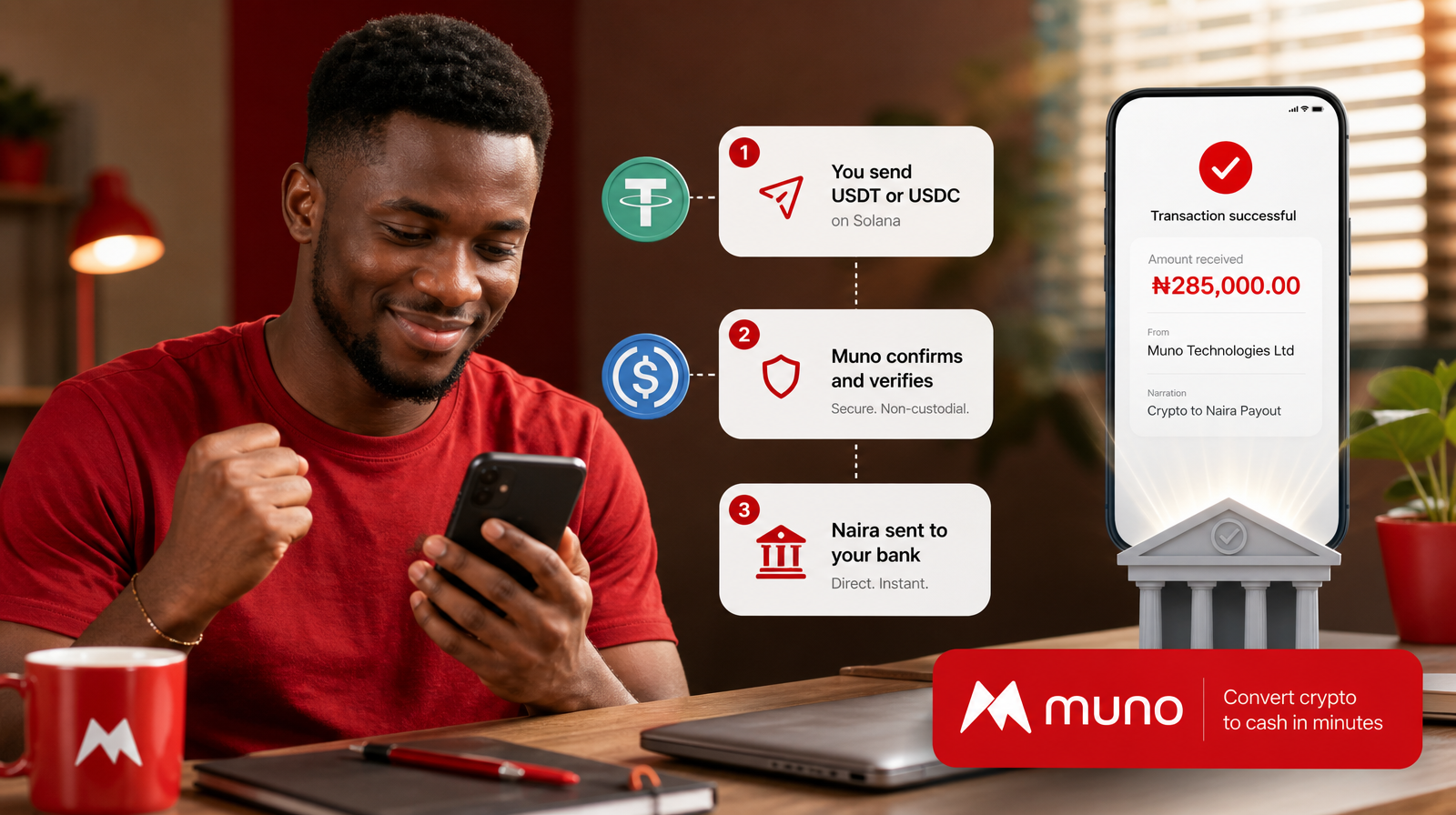
On Muno, the waiting works differently. After you send USDT or USDC on Solana, the naira reaches your bank in about 60 seconds — not from when you tap send, but from when the Solana network confirms your transfer. That distinction matters, and understanding it is the difference between trusting a process and simply hoping for one.
This article breaks down exactly what happens in that window: the network confirmation, the automatic payout trigger, the NIBSS settlement that delivers naira to your bank, and why the bank you use does not slow you down.
The Three-Step Muno Swap, Revisited
Before diving into the payout timeline, it helps to recall the three steps that get you to the moment of sending:
- Get a live quote. You type an amount and see the exact naira, fees included, before anything moves. The rate on the quote is the rate that settles — nothing hidden in a spread.
- Send the coins. Muno generates a Solana address for that one swap, with its own expiry. You scan it or paste it into your wallet and send the exact amount of USDT or USDC.
- Get paid. Naira clears to your bank around 60 seconds after the network confirms.
Steps one and two are under your control. Step three is where the infrastructure takes over — and it is the part most traders never see.
What "Network Confirmation" Actually Means
When you send USDT or USDC on the Solana network, the transaction does not arrive instantly. It is broadcast to the blockchain, where the network's validators process and confirm it. Confirmation is the network's way of saying: this transfer is real, the sender had the funds, and the coins have moved to the deposit address.
Solana is known for being a fast network — transactions are processed and reach finality in a matter of seconds rather than minutes. That is one reason Muno operates on Solana today: the confirmation step does not become a bottleneck between you and your naira.
But confirmation speed is not the same as payout speed. A fast network means Muno receives confirmation quickly. What happens next — the payout to your bank — is a separate process, and it is where the platform's design choices matter.
The Moment Confirmation Triggers Payout
Once the Solana network confirms your transfer, Muno's system recognises that the exact amount of USDT or USDC has arrived at the one-time deposit address generated for your swap. At that point, the payout process begins automatically.
Here is what makes this different from P2P: there is no person on the other side deciding when to send your naira. No buyer checking their phone, no chat negotiation, no manual release. The confirmation triggers the payout, and the naira is sent to the bank account you specified — the one in your own name, verified through NIN.
Muno is non-custodial, which means your coins stay in your wallet until the second you send them for a swap. There is no Muno balance to freeze, and nothing of yours sits with Muno in between. The one-time deposit address exists only for that specific swap, expires after its time window, and is never reused. One swap, one address, one payout.
NIBSS: The Bridge Between Muno and Your Bank
When Muno sends the naira payout, it does not go through a private channel or a workaround. It goes through NIBSS — the Nigeria Inter-Bank Settlement System — the central infrastructure that connects Nigerian banks and enables transfers between them. When you read that Muno pays out to "any NIBSS-connected bank or neobank," that is what it means: the naira travels through the same settlement rails that handle interbank transfers across Nigeria every day.
This matters for two reasons:
Speed is consistent across banks. Whether you bank with Kuda, GTBank, OPay, Moniepoint, Access, PalmPay, Zenith, UBA, Wema, First Bank, Sterling, Fidelity, or any of the 40-plus NIBSS-connected institutions Muno supports, the payout path is the same. The naira does not travel faster to a traditional bank than to a neobank, or vice versa. Same speed, whether it is Kuda or GTBank.
The naira lands in the bank you already use. You do not need to open a new account or maintain a balance anywhere. The payout goes to your existing bank account, in your own name, verified once through NIN so future payouts clear without holds.
Why "Around 60 Seconds" and Not "Instant"
Muno states that naira clears to your bank around 60 seconds after the network confirms. The word "around" is doing honest work. The timeline reflects the real processing steps stacked together after confirmation:
- Solana finality: the network confirms the transaction.
- Payout initiation: the confirmed swap is processed and the naira transfer is initiated.
- NIBSS routing: the naira travels through the interbank settlement system to your bank.
- Bank credit: your bank receives and credits the naira to your account.
Each step is fast, but each takes a small amount of time. Stacked together, they add up to roughly 60 seconds — sometimes less, sometimes marginally more. "Instant" would imply no process exists. "Around 60 seconds" acknowledges that a real, verifiable process is happening — one you can track.
Tracking and Alerts: No More Refreshing Your Bank App
One of the most unsettling parts of a P2P cash-out is the silence after you send. Muno replaces that silence with visibility: you can track your order status and receive payout alerts from the moment you send, through confirmation and payout initiation, to the naira landing in your bank. The payout alert tells you the transfer is on its way — you are not guessing.
For traders who have lost time or money to P2P uncertainty, that visibility is not a luxury. It is the core of what makes a cash-out feel safe.
Why Your Bank Choice Is Not a Speed Variable
A common question among Nigerian stablecoin traders is whether their particular bank will receive the payout quickly. That assumption usually comes from P2P experience, where some buyers bank with the same institution and transfers are internal.
With Muno, the bank you use is not a variable. Because every payout travels over NIBSS, any supported bank or neobank receives the naira through the same settlement infrastructure, at the same speed. If you already bank with a NIBSS-connected institution, you are ready — no account switch required.
The Quiet Speed Features: One-Time Addresses and NIN
Two design details do invisible work in keeping the payout fast.
The one-time deposit address. Because every swap generates a fresh Solana address, the system can automatically match your incoming transfer to your specific swap and payout instruction. There is no manual matching and no ambiguity about which transaction belongs to which customer. If you have ever had a P2P deal stall because the buyer was not sure which transfer was yours, you understand why this matters.
NIN verification, once. Verification happens a single time, upfront, so payouts clear to your own bank without holds on each transaction. It confirms that the receiving account is in your name — which is what allows the payout to flow straight through without manual review every time.
Authenticator 2FA adds a final guardrail: it is required on sign-in and on any payout change, so the bank account receiving your naira cannot be redirected without a second layer of verification.
What It Feels Like in Practice
The Muno website features a testimonial from Tolu A. in Lagos: "Sold 240 USDC at 11pm on a Sunday. Kuda credited before I closed the app."
That one sentence captures the 60-second window in real life. No waiting until Monday morning, no buyer negotiation, no chat. She sold USDC on a Sunday night, and the naira reached her Kuda account before she finished.
Another customer, Ifeanyi O. in Enugu, highlights the other half of the experience: "I can see the fee before I send. No surprise ₦8,000 going missing." Fee transparency and payout speed work together — you see the exact naira you will receive, and then it arrives.
Frequently Asked Questions
Does the payout start when I tap send? No. Tapping send initiates the blockchain transaction, but the payout clock starts after the Solana network confirms your transfer. That is why the stated timeline is "around 60 seconds after the network confirms."
What does the one-time address have to do with speed? It lets the system auto-match your confirmed deposit to your specific swap, removing manual matching and the delays that come with it.
Does my bank or neobank affect payout speed? No. All payouts route through NIBSS, so any supported bank or neobank receives the naira at the same speed.
How can I track my swap after sending? Muno provides order tracking and payout alerts covering each stage from confirmation to bank credit.
The Takeaway
The 60-second crypto-to-naira payout is not magic and it is not a guess. It is a sequence: Solana confirmation, an automatic payout trigger, NIBSS settlement, and your bank crediting the naira — supported by one-time addresses, one-time NIN verification, and order tracking so you can watch each step happen.
If you are ready to try it, the step-by-step selling guide walks through the full process, or you can price a swap directly at Muno.ng and see the exact naira before you send a single coin.