Two traders sell 100 USDT on the same afternoon. One receives the naira they expected. The other receives noticeably less — and never finds out why. The difference is rarely the headline rate. It is the fees: the ones you can see, and the ones you can't.
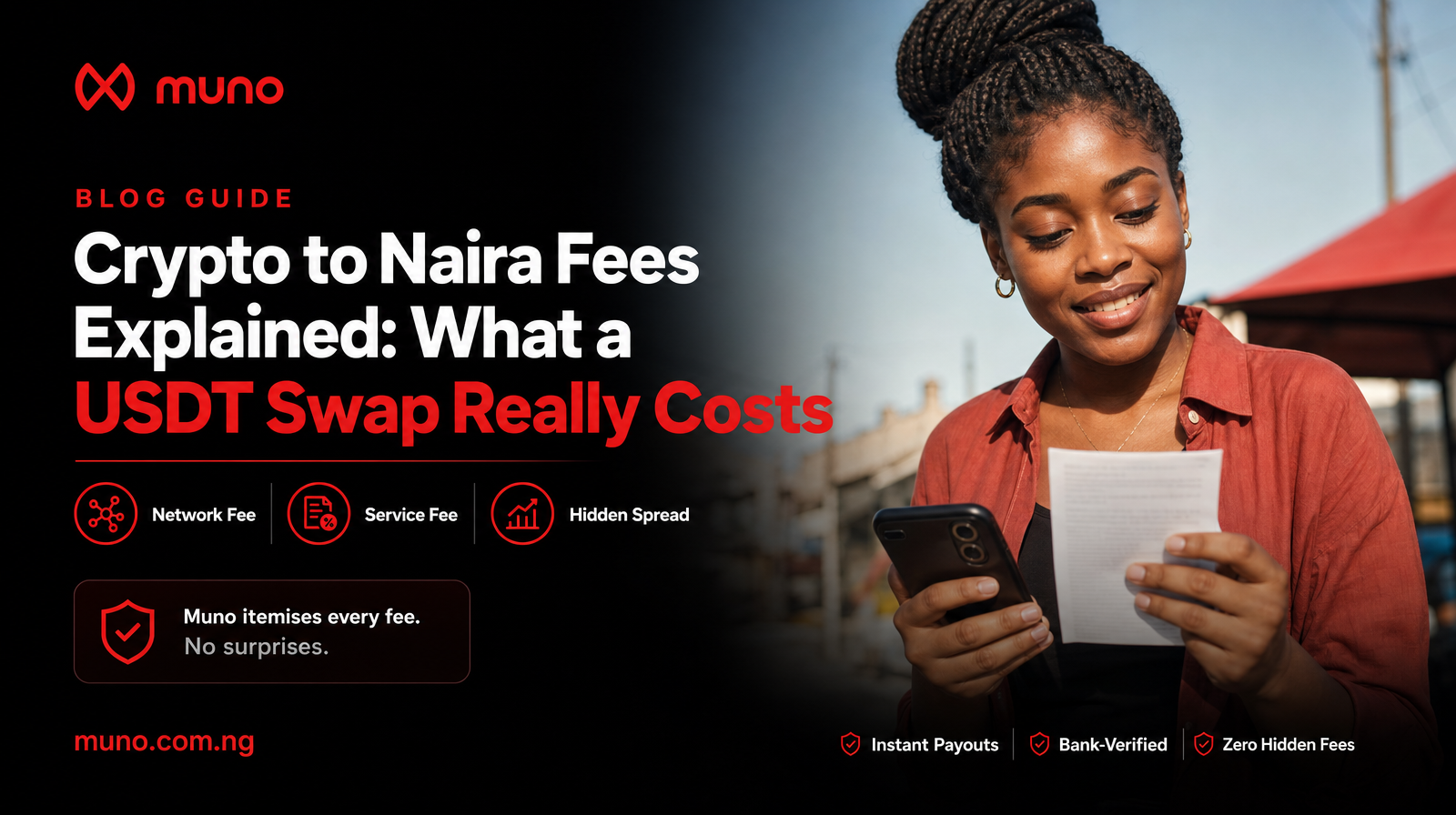
If you trade USDT or USDC in Nigeria, understanding how crypto-to-naira fees work is the single most useful thing you can learn before your next swap. A conversion has up to three cost layers — a network fee, a service fee, and a spread that may or may not be visible. This guide breaks down each one, shows you a real itemised quote line by line, and ends with a five-question checklist you can run on any platform before you send a single coin.
The three places your money can go
Every crypto-to-naira conversion involves up to three costs. Some platforms show you all of them. Some show you one and fold the rest into the rate.
1. The network fee. This is the cost of moving your coins on the blockchain — paid to the network, not the platform. On Muno, swaps happen on Solana using USDT and USDC SPL tokens, and the network fee appears as a naira line item on your quote rather than buried in fine print.
2. The service fee. This is what the platform charges for executing the swap: generating your deposit address, settling the trade and paying naira to your bank. On Muno this is a separate, itemised line on the same screen.
3. The spread. This is the one nobody lists. The spread is the gap between the real market rate and the rate you're quoted. A platform can advertise "zero fees" and still pay you less by quietly widening that gap. If all you see is one naira figure with no breakdown, the spread is where your money went.
That distinction answers one of the most common questions Nigerian traders ask: why did I receive less naira than the advertised rate suggested? Usually, the advertised rate was never the settling rate — the difference was absorbed by a spread you were never shown.
A worked example, line by line
Here is the exact shape of Muno's published sample quote when you sell 100 USDC on Solana:
- Rate: 1 USDC = ₦1,366.972
- Gross amount: ₦136,697.20
- Network fee: −₦2,000
- Service fee: −₦1,230
- You receive: ₦133,467
Read it top to bottom and nothing is ambiguous. The gross amount is simple multiplication: 100 × ₦1,366.972. The two deductions are named and priced. The final figure is the naira that lands in your bank.
Three things are worth noticing here:
- The rate on the quote is the rate that settles. It does not change after you've sent your coins, when your leverage is gone.
- Both fees are visible before anything moves. You can evaluate the full cost while your coins are still in your own wallet.
- Walking away costs nothing. Pricing a swap is free. If the numbers don't suit you, close it and come back later.
Why the order matters more than the number
The traditional way of cashing out in Nigeria works backwards. On P2P, you send coins or transfer naira first, then discover what you actually got — and your counterparty can simply go quiet after you've sent. Even on some platforms, the final payout is only revealed after the transaction is underway.
Muno flips that order. You type an amount and see the live rate, the network fee, the service fee and the exact naira payout before you send a single coin. No coins leave your wallet and no naira is promised to anyone until you accept the quote.
That's the real test of an honest fee structure: not what a platform claims on its homepage, but what it shows you while you still have the power to say no.
Is a zero-fee platform actually cheaper?
Not necessarily — and this is where most traders lose money without realising it.
"Zero fees" is a marketing statement, not a cost statement. A platform that charges no visible fee still has to make money somewhere, and the somewhere is almost always the spread. If the true market rate is ₦1,367 and the platform quotes you ₦1,340 with "no fees," you have just paid ₦27 per dollar — invisible, unitemised, and often larger than an honest service fee would have been.
The only reliable comparison between platforms is the final "you receive" figure for the same amount at the same moment. A platform with a slightly higher itemised service fee but a tighter, honest rate can put more naira in your account than a "zero fee" platform with a padded spread. That is exactly why Muno puts the final figure on screen, in full, before you decide.
Five questions to ask any platform before you swap
Whether you use Muno or not, run this checklist before your next conversion:
- Can I see the exact naira I'll receive before sending anything? If not, you're committing blind. A quote-after-send model means the platform controls the number at the moment you have the least power.
- Are the fees itemised? "Low fees" with no breakdown usually means a wide spread is doing the work. Look for a network fee and a service fee as separate named lines.
- Is the quoted rate the settling rate? Some platforms re-quote after you've sent. Ask — or test with a small amount first.
- Does the platform hold my money in between? Muno is non-custodial: there's no Muno balance to freeze. Your coins stay in your wallet until the moment you send, and the naira goes straight to your bank. We unpack why this matters in Who Holds Your Money When You Cash Out USDT in Nigeria?
- Where and how fast does the payout land? Muno pays out to 40+ NIBSS-connected banks and neobanks — Kuda, GTBank, Opay, Access and more — around 60 seconds after the network confirms.
Any platform that answers all five clearly is worth your trade. Any platform that dodges question one or two is telling you something.
Fees in context: cheap isn't the same as good value
Fees are only half the equation. The other half is the rate itself — how it's formed, why it moves, and why two platforms can quote different numbers in the same minute. For that side of the picture, read How Crypto to Naira Rates Work: A Nigerian Trader's Guide.
And if you're holding both stablecoins and deciding which to sell, the fee structure applies equally to each on Muno — but USDT vs USDC to Naira: What Nigerian Traders Should Check First walks through the asset-level differences worth checking.
The bottom line
A fair crypto-to-naira swap has a simple signature: a live rate, a network fee and a service fee — all visible, all itemised, all before you send. Two fees you can read, and no spread doing silent work in the background. Anything less transparent is a cost you just can't see yet.
The next time you're about to cash out, don't ask "what's the rate?" Ask "what do I receive, and can I see it first?"
Price a swap at Muno.ng and see the exact naira before a coin moves. It costs nothing to look.